Application classIndustrial automation and process equipment
CategoryFlow Control
Specifications
Identification
Model family
Brooks Instrument 0550E
Function
Device type
Analog thermal mass flow controller for gases
Sensing principle
Thermal mass-flow measurement using a heated sensor tube
Electrical
Primary power
0550E family: 105–125 VAC, 50/60 Hz, 15 W maximum
Command input
0550E family: 0–5 VDC at 0.25 mA
Flow outputs
0550E family: proportional 0–10 VDC output with 2 kΩ minimum load and 0–1 VDC output with 1 MΩ minimum load
Mating connector
0550E family: Amphenol 165-10
Performance
Specified control range
0550E family: 2–100% of calibrated full scale
Accuracy
0550E family: ±1% of full scale over the specified range at calibration conditions
Repeatability
0550E family: 0.25% of rate over the specified range
Response
0550E family: output within 2% of full scale of final value in 5 seconds or less for step changes between 3% and 100%, including transitions to or from valve override
Warm-up time
0550E family: 40 minutes
Environmental
Operating temperature
0550E family: 15–45 °C
Pressure
Calibration pressure
0550E family: 25 psig
Pressure-boundary maximum
0550E family manual maximum: 1500 psig; allowable system pressure may be lower for a configured fitting, seal, or installation
0550E family: less than 2% of full scale; the control valve is not a positive shutoff device
Mechanical
Weight
0550E family: 5 lb 10 oz (approximately 2.55 kg)
Standard process connections
0550E family: 1/4-inch compression adapters; optional compression, -4/-8 VCO, and -4 VCR adapters were offered
Reference conditions
Standard flow conditions
0550E family: 70 °F (21.1 °C) and 760 mm Hg
Calibration-specific configuration
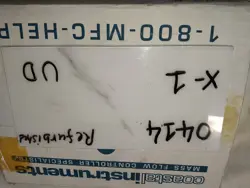
The 0550E is calibrated for a specified gas and full-scale flow. This archive record's photographed controller is explicitly labeled for 20 slpm nitrogen, while a separate physical unit offered under the same full identifier was described as 3 slpm nitrogen. The label or current calibration certificate attached to the physical controller therefore governs its gas, range, pressure conditions, and mounting orientation.
Electrical terminal highlights
Selected 0550E connector assignments documented in the manufacturer manual.
Terminal
Function
Documented behavior
D
Precision reference
5 V ±0.2%; use with a potentiometer of at least 1 kΩ
E
Signal common
Command-input return and common for the voltage flow outputs
F
Command input
0–5 VDC setpoint
H
Valve override
+10 to +24 VDC opens the valve; -10 to -24 VDC closes it; -5 to +5 VDC or floating permits normal operation
K
Closed-limit output
Open-collector limit indication; sinks up to 50 mA when active
L
Open-limit output
Open-collector limit indication; sinks up to 50 mA when active
M
Flow output
0–10 VDC proportional flow signal
N
Flow output
0–1 VDC proportional flow signal
Compatibility and replacement context
Interface compatibility does not establish a universal drop-in replacement; gas calibration, full scale, pressure conditions, seals, fittings, footprint, and valve behavior must also be matched.
Original-system interchangeabilityThe 0550E manual states interchangeability with the Applied Materials AFC 550 when the valve-inhibit function is not required.
Later Brooks replacement interfaceThe Brooks 5800S ordering information identifies a 0–5 VDC input / 0–10 VDC output option as the 0550E replacement configuration.
Installation and safety notes
The control valve provides proportional control but is not intended for positive shutoff; install a separate shutoff valve where positive isolation is required.
Install an upstream filter appropriate to the calibrated full-scale flow to protect the sensor and valve from contamination.
Where practical, provide at least ten pipe diameters of straight tubing immediately upstream to reduce installation-induced accuracy shifts.
The controller may be mounted in any position, but changing from its calibration orientation can produce a shift of up to ±0.5% of full scale after re-zeroing.
Purge the controller with nitrogen before startup and when removing it from reactive, corrosive, or toxic-gas service; hazardous-gas handling and decontamination must follow the manufacturer’s safety instructions.